Showing posts with label Uniquely China. Show all posts

Sunday, May 25, 2008

Guilin and Yangshuo

A group of us went to visit Guilin and Yanshuo for a long weekend. These cities are located in Guangxi Zhuang Autonomous Region is located in the southern part of China and borders on Vietnam. Its landscapes and natural sites are unique and beautiful. Guilin is known for its limestone peaks and beautiful landscape.


When we arrived at Guilin airport we took a bus to The Dragon’s Backbone Rice Terraces in Longsheng. It was a couple hour ride to the rice paddies with some beautiful scenery. This area is also known for its ethnic minority groups that are allowed to continue to their unique traditions and culture. We met some Yao, Miao, and Zhuang people.


After visiting the Terraces we drove back Yanshuo to stay in a very nice hotel. We did not arrive in town until very late.
The next morning we took a boat cruise up the Li River. Most people take the boat from Guilin to Yanshuo (downstream). We did just the opposite and were the only people on the boat (wow). The scenery was spectacular. We had some intermittent rain but that was a good relief the the hot humid climate.


Here we are posing with the 20 Yuan bill which has the same scenery on the back of the currency.


We took a bus back to Yangshuo and then went to a fantastic outdoor show (Impression show of Liusanjie) that was produced and directed by Zhang Yimou the famous Chinese director who will be doing the opening ceremonies for the 2008 Olympics. The show was about the river people and life along the Li River. It was a great light spectacle in a large amphitheater with over 6,000 local actors.


The next morning we visited moon hill near a local village.


We then headed for the city of Guilin and went to Reed Flute Cave


Monday, May 12, 2008

Another New Experience

We experienced another first today while living in China. I was on the 28th floor of our office building in the Central Business District in Beijing in the middle of a 2:30 pm meeting with a work colleague. I thought I was fainting and my colleague was looking at me strangely confirming that something was wrong with me. My only thought was not to pass out or vomit. Then I noticed the lights and the window shades were swaying. I then realized that our whole building was moving back and forth.

My first thought was that nearby construction had caused this or faulty construction of the building was going to result in a catastrophe. We all exited the building through the stairwell. I left me coat, mobile phone, and blackberry and exited quickly. The building was still moving while getting to about the 25th floor. Everyone was very orderly exiting in the stairwells.

We all gathered on the side walk across the street, then decided to move further away from the building. After some discussion and consultation with the blackberry we realized we had just experienced an earthquake. One earthquake was 7.8 and centered in Sichuan Province where the Three Gorges Dam is located on the Yangtze (950 miles from Beijing). Another one was a 3.9 which was centered in Tongzhou District in east Beijing at roughly the same time.

After 10 or 15 minutes on the side walk, a fight broke out and was coming our way. We noticed that 6 or 7 men were chasing another man. They knocked him to the ground and then began stomping him. The attackers ran off and the man got up and began calling on his mobile phone and was looking for his attackers who scattered. It was very difficult to tell what was going on and why the man was attacked.

We returned to the building after about an hour with no aftershocks felt. Another life experience in China............

Sunday, May 04, 2008

Yangtze River Cruise

Three couples from our apartment building went on a Yangtze River cruise in May. We flew to Chongqing to start the cruise which ended 3 days later at Three Rivers Gorge Dam.

Here we are arriving at Chongqing airport. Chongqing (also once known as ChungKing) is the largest municipality in China with over 31MM people.


Chongqing is a very hilly city in a very warm climate near Sichuan Province. We did a little sightseeing and ate at a hotpot restaurant before boarding our cruise ship.


Below we are arriving at Fengdu (ghost) City. The river cruise ship we traveled on is in the background.

The T-shirt I am wearing was a gift of an expat who has lived here for 13 years. It always gets laughs from the locals - bei ren kan pu dong - "white men don't understand" (westerns can't read this).


Very strange demonic statues along the walk up the hill to a temple.


This small guy has a great business. He rolls this huge iron object around a vertical pole and then has to lift it up on top of the pole Everyone is challenged to do it and of course no one can. He has a great technique that he has perfected. On our way back to the ship he caught up with BF to see if she would exchange all of his Dollars for Yuan. That is how weak the US Dollar is :(

He did not like me too much. He thought I was a foreign devil (large westerner with sun glasses). He was glad to see me go.


Sights of the river and gorge. The river has been flooded to 152M and will be complete when it reaches 175M in the near future.


The very controversial Three Gorges Dam, in Hubei Province, largest in the world.

Thursday, April 24, 2008

Chinese Nationalism Going Too Far?

I apologize in advance and you can skip this entry if you are not interested in the political situation in China. It is something that is real for me here. It is a very different way of viewing things and cannot be taken lightly when you have to work with the Chinese government every day.

The Communist Party is starting to be concerned about the protesting and anti-west sentiment. The government has concerns that this could impact the Olympics as well as could get out of control and the protests turn to other issues in China. Here is a good Wall Street Jounral article that points out the issues concerning the Communist Party.

The Chinese government is moving to tamp down nationalistic anger over Western criticism of Beijing's policies in Tibet.
By GEOFFREY A. FOWLER and JULIET YE in Hong Kong, and LORETTA CHAO in BeijingApril 24, 2008; Page A6

In the latest sign, authorities informed participants in a major music festival that the event would likely be postponed to avoid providing a venue for new demonstrations of patriotic or anti-Western sentiment. Already, they have been cracking down on student protests and online videos of demonstrations have disappeared from Chinese Web sites.

It is a familiar pattern: Chinese nationalism rears up, sometimes with what seems to be tacit government backing, only to get reined in before it threatens to spin out of control -- in this case, before it can mar preparations for the summer Olympic Games in Beijing.

At Nanjing Normal University, researcher Guo Quan says counselors have been told to "manage student sentiment." On Monday, he says, universities around China were told by the central government to stop all protests.
Such fervor that has generated protests against French retailer Carrefour SA in nine cities and cyberattacks on American media.


"The Chinese government is trying to cool patriotic fervor now, because it believes that it has already achieved the desired goal: to tell the world that Chinese are protesting against the French," says Mr. Guo. "We're in a time when there are lots of other social problems such as a troublesome stock market, and rocketing commodity prices might drive people's anger to a larger scale."

The student crackdown appears to be particularly strong in the city of Hefei, in the eastern province of Anhui, where on Saturday, thousands protested outside a Carrefour store near the city's university district, waving red flags and chanting "love China, boycott Carrefour." On Sunday, universities there suspended classes and asked students to stay on campus, students say.

The Communist Youth League, a division of the Communist Party with a big presence on Chinese campuses, has been arranging meetings and distributing propaganda to calm nationalistic sentiment, say students. The Anhui branch of the Communist Youth League declined to answer questions.

"The atmosphere here on campus is a bit intense at this moment," said a Ph.D. student surnamed Shen from Hefei's China Technology and Science University. "Those who went out for the weekend protest were called for a talk in counselors' office this week," she said.
Some Chinese have reported difficulty sending text messages such as "boycott Carrefour" and "don't shop at Carrefour" on the cellular network run by China Mobile Ltd., the country's largest cellphone carrier. Rainie Lei, a spokeswoman for China Mobile, said the company wasn't blocking any such messages.


In Beijing, participants in the Midi Music Festival that had been scheduled to start May 1 were informed on Wednesday that the event likely will be postponed to October due to safety concerns. Zhang Fan, the festival's director, said he thinks the authorities are "afraid that the participating music fans and young people will conduct Tibetan or anti-West" demonstrations.
Last month, Icelandic singer Björk declared "Tibet! Tibet!" at a concert in Shanghai, embarrassing authorities.


"It's very regrettable," said Mr. Zhang, who noted that some foreign bands are already in China for the show. "Midi is a very good opportunity to show the world that Chinese society is happy, equal and free. Western media always says China suppresses people, but Midi shows that China's young people are so happy, so looking forward to welcoming the Olympics."

Kou Zhengyu, a guitarist who planned to play at the Midi festival, said while he felt "music has nothing to do with politics," he also "could understand the government decision. The government must worry about the safety issue."

After initially trying to play down coverage of Olympics torch-relay protests in London and Paris, the Chinese government went on a public relations offensive. Jin Jing, a wheelchair-bound torch bearer in Paris who was attacked by a protester, became a Chinese hero. An April 11 editorial by Xinhua, the state-run news agency, said "Chinese people are seriously disturbed and hurt" by the incident involving Ms. Jin. French President Nicolas Sarkozy later apologized to Ms. Jin personally over the matter.

Some Chinese started calling for a boycott on French products, and in particular Carrefour, which has a significant presence in China.

But late last Thursday, the government's rhetoric began to change, with a call from Xinhua for "patriotic zeal to concentrate on development."

A news editor at Phoenix Television, a Hong Kong-based Chinese news broadcaster with ties to Beijing, said news, pictures and video of the anti-Carrefour protests weren't allowed on air. Xinhua reports said the protests were targeted against "Tibet independence," not against foreigners. (News Corp., owner of The Wall Street Journal, owns a minority stake in Phoenix.)
China has periodically seen major student outbursts of patriotism. In 1999, after the Chinese embassy in Belgrade was bombed by a North Atlantic Treaty Organization mission, students across China engaged in occasionally violent protests against "American hegemony." (NATO contends the bombing was accidental.) After a few days, during which students vented their anger, the government told the students to stop protesting and go back to school.


This time, China can't afford to let the backlash continue too long without poisoning the atmosphere for the Beijing Olympics, which is just over 100 days away. The event is expected to bring throngs of visitors to China, including 25,000 foreign journalists.

Nationalism and sports have proven to be a volatile mix before in China. After a 2004 Asian Cup soccer final between China and Japan held at Beijing's Workers' Stadium, hundreds of Chinese fans rioted, throwing bottles and yelling at police. China had lost the game 3 to 1.

Another factor that separates the recent spate of nationalism from past student uprisings is the Internet, now a major cultural force in the lives of young Chinese people. According to official Chinese data, the country has more than 210 million Internet users, the majority of whom are under the age of 30.

The Internet developed into a significant platform for organizing protests and venting anger with foreign attitudes toward China. Users created countless patriotic videos detailing the crimes of the West against China. Millions of people using the MSN messaging program promoted their patriotism by adding a heart symbol and "China" next to their names.

There have been some efforts in recent days to curtail online displays of nationalism. Some videos of the Carrefour protests available earlier on sites such as Tudou.com are now gone. A Tudou spokesman declined to comment, but Chinese Internet-media companies routinely remove content that violates their antiviolence or antipornography-service agreements, or which they feel may be objectionable to the government.

Moreover, some Chinese hackers who had planned a significant attack on the Web site of Time Warner Inc.'s CNN, a major source of nationalistic resentment over its coverage of the recent unrest in Tibet, appear to have withdrawn. While CNN.com did experience an attack that affected users in Asia last Friday, hacker Web sites in China had promised much more.The posts by some organizers of the attack calling for disbandment have an edge of "fear" to them, says Scott Henderson, author of the book Dark Visitor, about Chinese hackers. One in particular "could not have added many more exclamation points in his announcement," he said. "It was a 'PLEASE DO NOT HACK!!!!!!!!!' sort of plea."

Monday, April 21, 2008

BF and Calligraphy

I want to share with you something that I am doing that is so very interesting to me (BF).

Today was my 4th calligraphy class. I take class with a girlfriend of mine. Our classroom is located in the park that houses the ancestral temple. It is at the south east corner of the Forbidden City (Imperial Palace). The school is for those sitting for entrance exams into Art School at the undergraduate, graduate, and doctorate levels. I have a card with the schools name on it and my own name Fei Pu Lan that lets me into the east side of the Palace grounds. It is beautiful and our door faces a rock mountain that has stairs to climb up high to see. How cool is that? Way cool.

We attend class once or twice a week and are learning the most recognised style of calligraphy, the Cai style. We copy the work of a master from a book. The book is of rubbings taken off steles. That is how work is immortalized.

Our teacher is a famous calligrapher, painter, and carver in his own right. He tells us that to be a good painter we must have the firm grounding of well done calligraphy. From this our own style will emerge and then we can move onto painting (or, writing a picture).
This is one of his works of calligraphy. He likened it to being in the perfect state of mind to create and this is the work that resulted. He could not duplicated the emotion and feeling of this work. He dips his brush only once in a while, unlike us, who want perfect characters.

He is the son of an artistic family. His mother created beautiful embroidery. She embroidered with silk on silk. She created birds with eyes that looked alive and beaks that looked as though in song. His father was a very skilled caligrapher.

He began practicing calligraphy in school at the age of 6. By the age of 10 he was a very popular choice with the people in his village to paint the new year greetings the are hung by the front door.

To be considered a master painter, one must write the picture, create a poem and have beautiful calligraphy to apply it to the painting, and to create and carve your own chop (the red stamp).

Our teacher was interested in learning how to carve chops when he was young. The stone is expensive so he would fashion a block suitable for carving from clay to practice on. He went on to study this form of art at university. He has won many awards for his chops. His chops are small works of art.

Here is a sample of my work. Our teacher is a very simple and humble man. He will circle the characters that are good and paint over the incorrect strokes.

I think his technique for teaching us is to start us on this style of writing and sit back and see what we do with it. He waits for questions from us.

We spend 4 hours each class painting. We stand to practice the calligraphy. We will be studying this same style painted by the same master when he was much older and more mature. We also hope to learn one other style.

I hope to supplement my painting with understanding of what the character means and how it fits into the poems we are copying. I understand from my friend that this is not the traditional way that she learned. This is a much nicer way. I will take her word for it. Our teacher has work displayed in this 300 page book. He graciously offered to sign a book to each of us. The inscription is read from right to left and top to bottom. The first line says to student Fei Pu Lan and some sort of courtesy. The second line is the date. The third line is the name of the school we attend. The last line is two characters and is our teachers name.

He has incorporated 5 chops onto the dedication. Two are his last name. One is an art piece. One is the town he is from and the last is his first name. They are really interesting.This is a piece that my teacher is helping me to learn. These four characters together mean family and all of the best things that family life brings. This is his writing. My task is to copy it, and learn it.

I am off to practice my calligraphy for today. I am asked to practice one to two hours a day. I like to do it when it is quiet.

Saturday, April 19, 2008

Sudden Change in Chinese Public Perception

France was once considered one of the most admired western countries by the Chinese people. That has changed very quickly. Chinese citizens who were always very favorable to westerners here are starting to become vocal against the French. One recent example occurred at a foot massage establishment. The young girls were trying to communicate with us to inquire as to our views about France and Sarkozy. IT was an odd mixture of Mandarin, English and body communication. Regardless they were able to get there negative feelings across about the French. Here is the contents of a SMS that is spreading across China. Not only is Carrefour being boycotted but products like L'Oreal that are very popular here.

We hope you are able to boycott Carrefour at least on 1 May, to deliver, by the empty Carrefour that day, one message to the western world: Chinese shouldn’t be humiliated! Chinese people shouldn’t be insulted!
 The boycott against Carrefour is going to spreading all over the country, and we anticipate your presence! Thank you. The Olympic torch relay that just ended in Paris is not as peaceful as most of Chinese know about. Let’s see what French and its government have done when Chinese carried the torch, a symbol of peace and friendship into their territory.
1. Before the relay, a French TV station called on people to protest on street for the reason that they “don’t want Chinese flags flaunting all over”.
2. The torch was forced to extinguish for 4 times under the violent disruptions of Tibet separatists.
3. The French police in charge of security simply stood by to see the separatists snatching the torch, and striking the disabled torch carrier.
4. At where the torch went by, hordes of French waved the flag of separatists, clamoring “Free Tibet’, “Shame on China” to protest against China.
5. Groups of young men even scrambled the Chinese students’ Five-star flags and tore them up, two sides in conflict.
6. When the sacred fire passed by the City Hall of Paris, the banners and slogans of pro-Tibet independence were hung out and all the alderman put on the pro-separatism badges, a behavior that made the planned ceremony there cancelled.
7. The major media in France reviewed the torch relay with such headlines— Fiasco in Paris(Figaro) and A Slap on China.

Monday, March 24, 2008

The Olympic Torch

The Olympic Flame will be lit in Olympia, Greece according to tradition on March 24, 2008. From March 24-29, the Torch Relay will travel across Greece, ending at the Panathinaiko Stadium, the site of the first modern Olympic Games in 1896. After the handover ceremony in the stadium, the Olympic Flame will arrive in Beijing on March 31, 2008. In Beijing, a ceremony will be held for the arrival of the flame into China and Beijing 2008 Olympic torch relay will commence.

The cities along the route are:
Beijing; Almaty; Istanbul; St.Petersburg; London; Paris; San Francisco; Buenos Aires; Dar Es Salaam; Muscat; Islamabad; New Delhi; Bangkok; Kuala Lumpur; Jakarta; Canberra; Nagano; Seoul; Pyongyang; Ho Chi Minh City

The provinces and cities in China that will participate in the torch relay are:

  • Hong Kong

  • Macao

  • Hainan Province (Sanya, Wuzhishan, Wanning, Haikou)

  • Guangdong Province (Guangzhou, Shenzhen, Huizhou, Shantou)

  • Fujian Province (Fuzhou, Quanzhou, Xiamen, Longyan)

  • Jiangxi Province (Ruijin, Jinggangshan, Nanchang)

  • Zhejiang Province (Wenzhou, Ningbo, Hangzhou, Shaoxing, Jiaxing)

  • Shanghai

  • Jiangsu Province (Suzhou, Nantong, Taizhou, Yangzhou, Nanjing)

  • An'hui Province (Hefei, Huainan, Wuhu, Jixi, Huangshan)

  • Hubei Province (Wuhan, Yichang, Jingzhou)

  • Hunan Province (Yueyang, Changsha, Shaoshan)

  • Guangxi Zhuang Autonomous Region (Guilin, Nanning, Baise)

  • Yunnan Province (Kunming, Lijiang, Xamgyi' nyilha)

  • Guizhou Province (Guiyang, Kaili, Zunyi)

  • Chongqing

  • Sichuang Province (Guang'an, Mianyang, Guanghan, Leshan, Zigong, Yibin, Chengdu)

  • Tibet Autonomous Region (Shannan Diqu, Lhasa)

  • Qinghai Province (Golmud, Qinghai Hu, Xining)

  • Xinjiang Uygur Autonomous Region (Urumqi, Kashi, Shihezi, Changji)

  • Gansu Province (Dunhuang, Jiayuguan, Jiuquan, Tianshui, Lanzhou)

  • Ningxia Hui Autonomous Region (Zhongwei, Wuzhong, Yinchuan)

  • Shaanxi Province (Yan'an, Yangling, Xianyang, Xi'an)

  • Shanxi Province (Yuncheng, Pingyao, Taiyuan, Datong)

  • Inner Mongolia Autonomous Region (Hohhot, Ordos, Baotou, Chifeng)

  • Heilongjiang Province (Qiqihar, Daqing, Harbin)

  • Jilin Province (Songyuan, Changchun, Jilin, Yanji)

  • Liaoning Province (Shenyang, Benxi, Liaoyang, Anshan, Dalian)

  • Shandong Province (Yantai, Weihai, Qingdao, Rizhao, Linyi, Qufu, Tai'an, Jinan)

  • Henan Province (Shangqiu, Kaifeng, Zhengzhou, Luoyang, Anyang)

  • Hebei Province (Shijiazhuang, Qinhuangdao, Tangshan)

  • Tianjin

  • Beijing

Red highlight used for the few cities we have been to in China. The country is slightly larger in geography than the US.


One of the highlights of this leg will be the attempt to bring the Olympic Flame to the highest peak in the world Mt. Qomolangma. During the arrival ceremony for the flame into China on March 31, 2008, one of the lanterns with the Olympic Flame will be kept aside. The torchbearer team will then attempt to take the Flame to the highest peak on a day in May that presents the best climatic conditions for the ascent. Torch assault point: 8,300m above sea level


The torch will not pass through Taiwan as China had hoped. See China Daily news article: Beijing 2008 Olympic Torch Relay can not pass through Taipei


High Priestess is selected for Olympic Torch lighting: High Priestess for Lighting Ceremony decided


As reported in China Daily

Tuesday, March 18, 2008

Sandstorm Arrives in Beijing


We experienced our first sandstorm in Beijing this morning after getting in to work. The sky looked ominous and was a strange color. Then I could smell dirt in the air in the office. A couple of windows blew open to let even more dirt into the indoor air. My nose and throat have been burning ever since. The storm lasted for about 4 hours. The air has improved but is still quite polluted of full of dirt. Here are before and after pictures.

Check out the weather channel report for Beijing (blowing sand and 50 degrees)

Sunday, March 16, 2008

Censorship Part II

With all the protests and activities in Tibet, the censorship story has become even stranger. On Friday and most of Saturday BBC and CNN were blocked when any news on Tibet came up. Then later on Saturday we could occasionally see a report on BBC. Also CCTV 9 which is an English speaking news station here in Beijing reported on the damage that the Tibetan rioters had done to Han Chinese property.

On Sunday afternoon, Beijing was allowing CNN to show a live video stream that I believe was also being shown in the US by some unknown person to a Hong Kong TV station. This was very strange as to why they were allowing this. Then the Dali Lama came on to speak and again the broadcast was blanked. The Beijing government feels that the Dali Lama is the cause of all the unrest and view him as a national threat. I included this interesting article about the Chinese chosen Panchem Lama:

China's official Tibet Buddhist leader condemns riots
BEIJING (Reuters) - China's top state-favoured Tibetan Buddhist leader has condemned the riots that shook Lhasa, state media said on Sunday, but the tightly controlled teenager appeared to avoid directly criticising the exiled Dalai Lama.

The Panchen Lama ranks second to the Dalai Lama in the hierarchy of Tibetan Buddhism.
After the 10th Panchen Lama died in 1989, Beijing and the Dalai Lama made rival choices for his successor, and the Dalai's choice, a boy then aged six, disappeared into the control of Chinese authorities.


But according to the Xinhua news agency, Beijing's choice, 18-year-old Gyaltsen Norbu, has come out backing the government condemnation of protests that left parts of Tibet's regional capital Lhasa smouldering with torched vehicles and shops.

"The rioters' acts not only harmed the interests of the nation and the people, but also violated the aim of Buddhism," he said, according to an English-language report from Lhasa.
"We strongly condemn the crime of a tiny number of people to hurt the lives and properties of the people," he said.


Chinese authorities have said the Dalai Lama directly caused the protests, which snowballed from peaceful marches by monks.

But the 11th Panchen Lama, at least in the published comments, did not condemn the Dalai Lama, whom China reviles as a "separatist" while most Tibetans venerate him as a spiritual leader, even though his image is banned.

Tibetans widely disdain Beijing's choice for the 11th Panchen Lama, but tradition dictates the Dalai and Panchen lamas should recognise each other's reincarnations.

Reuters

I am so glad that we decided to go to Tibet last year. I cannot see the Beijing government allowing foreign tourist in the area any time soon.

Wednesday, March 12, 2008

Paintbrush maker Mr. Zou

Tuesday March 11, 2008
My painting teacher arranged for a small group of us to visit the home and workshop of her favorite Chinese paint brush maker. Mr Zou has learned this craft from his father and it has been practiced for many generations in his family.

There were 2 cars of us going; 6 in all. We drove into an area that is being demolished and built up at the same time. We met a man on a motorcycle at the entrance to all of the construction. I didn't know it was Mr. Zou himself.


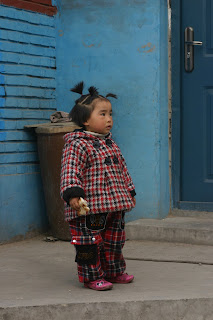
These darling little children watched as we drove up and were at once curious and wary. They are holding their mid morning snack of bread in their hands.


We walked along this alleyway for some time following Mr. Zou.


We passed this doorway where a young girl was showing an even younger girl her drawings.


At last we cross the gate and will enter his home.


This is his workshop. He finishes the brushes here. The basic work of sorting the hair and making the tip is done at his factory in Tianjin.


He showed us pictures of himself sorting goat hair.

Here he is straightening the hair. He uses steam to make curly hair go straight.


This machine cuts the horn he uses into the lengths he needs. Horn is used because it is hollow and strong and beautiful.


He is putting the tip of the brush into the handle.

He is combing the hair to get all of the loose ends out.

This is his wife. She is using a string attached to the table leg to squeeze the excess glue out of the tip of the brush. The brush is dipped into a glue that is made out of sea sponge cooked in water.

He is working on a fancy brush. Most of those lying on the counter are for the tourist market. We were interested in the ones he wasn't going to take to the market.

She is smoothing the hairs. The glue and rigid tip make it much easier to transport..but harder to determine the quality of the brush and the kind of hair it is made from.

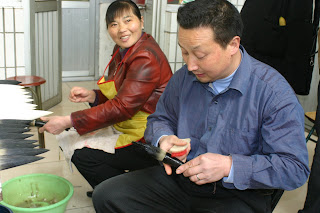
The last step is to run a thin knife along the top hairs to straighten the top layer.

This is a brush made from horse hair. Mr. Zou carved the handle himself.

Someone asked how the hair is held together and put into the handle. Mr. Zou is demonstrating tying the hair together with a string.

The end hairs that get pushed into the handle are cut to the exact same length. A strong glue is used to fasten them into the handle.


Mr. Zou is showing us his calligraphy. He was taught calligraphy as a young child so that he would learn the important components of a good brush. Calligraphy is more precise than painting.

He brought out brushes for us to purchase. They all have protective plastic caps on them.

Our painting teachers driver was painting a horse with water on the trying board.

I learned alot and it is always a pleasure to go to someones home. Mr. Zou offered us bananas and oranges and water.